If you are looking for a simple, safe and completely free way to enjoy movies and series on your cell phone, tablet or TV, Tubi – Free Movies and Series stands out as one of the best options available in 2026. With an impressive collection, a clean interface, and support for Portuguese subtitles, the app offers access to thousands of titles free of charge. And best of all, it's available for direct download from the official stores:

Tubi: Free Movies & Live TV
Smart Manufacturing Systems: Complete Guide to Building a Connected Factory
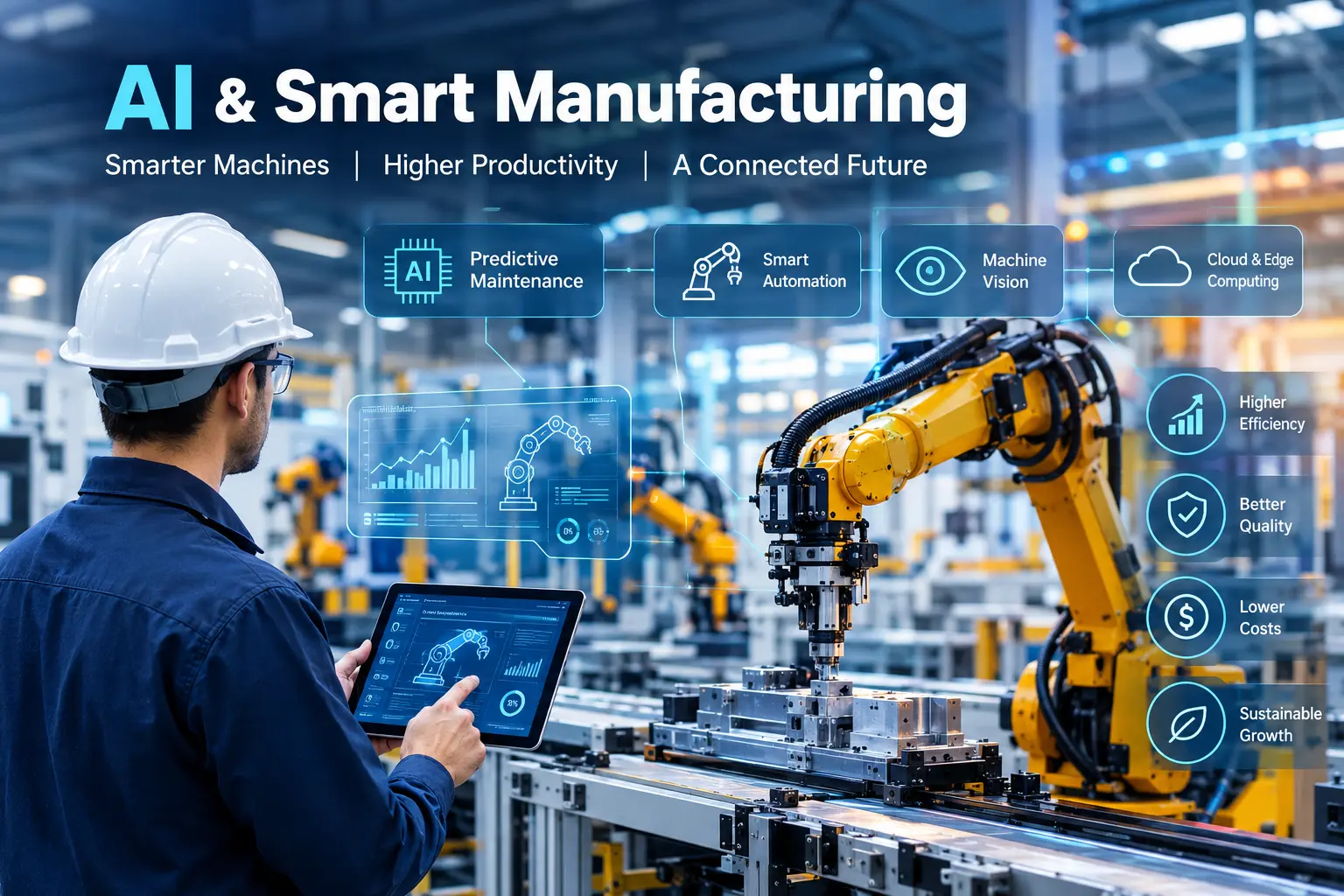
A connected factory is often confused with an automated factory, but the two are not the same thing. A plant can be heavily automated, with robots welding car frames and conveyors moving parts between stations, while still being almost entirely disconnected, with each machine or automation island operating on its own island of data that never reaches a broader system. A truly connected, smart manufacturing operation goes a step further, weaving data from every machine, sensor, and system into a shared, accessible flow that supports real time visibility, analytics, and increasingly autonomous decision making across the entire operation rather than within a single isolated station.
Building this kind of connected factory is a significant undertaking that touches nearly every layer of a manufacturing operation, from the physical sensors on the floor to the enterprise software used by finance and supply chain teams. This guide walks through the complete technology stack required to build a connected factory, the key protocols and standards that make that connectivity possible, a practical implementation roadmap, and the security and organizational considerations that determine whether the effort actually succeeds.
What Actually Makes a Factory Connected
A factory earns the label connected when data generated anywhere in the operation, whether from a machine sensor, a quality inspection camera, or an inventory system, can flow reliably to wherever it is needed, whether that is a maintenance technician's dashboard, a cloud based analytics platform, or an enterprise resource planning system used to plan next quarter's production. The defining characteristic is not the presence of any single technology, but the elimination of the data silos that have traditionally kept information trapped within individual machines, departments, or software systems that were never designed to talk to each other.
The Complete Smart Manufacturing Technology Stack
Layer One: The Device and Sensor Layer
At the foundation sits the physical hardware that generates raw data, including programmable logic controllers, industrial sensors measuring vibration, temperature, pressure, and current, cameras used for quality inspection, and increasingly, sensors embedded directly into modern machinery by its original equipment manufacturer. This layer also includes actuators and controllers capable of receiving commands and physically adjusting equipment, since a truly connected factory needs the ability to act on data, not just collect it.
Layer Two: The Connectivity and Network Layer
This layer carries data from devices on the floor to wherever it needs to be processed, and increasingly includes a mix of wired industrial Ethernet, wireless sensor networks, and private cellular networks for applications requiring mobility or coverage across a large facility. Network design at this layer needs to balance reliability, since a lost connection can mean lost production data or, worse, a machine unable to receive a safety critical command, against the practical cost and complexity of running new cabling throughout an existing facility.
Layer Three: The Edge Computing Layer
Edge computing devices positioned close to the machines they serve handle time sensitive processing that cannot tolerate the latency of sending data to a distant cloud server and waiting for a response, such as real time quality inspection decisions or safety critical process adjustments. This layer also often performs initial data filtering and aggregation, reducing the volume of raw data that needs to be transmitted further up the stack while preserving the meaningful signal within it.
Layer Four: The Unified Data and Namespace Layer
This is arguably the most important and most frequently underinvested layer in a connected factory architecture. A unified namespace acts as a single, organized, real time source of truth for data across the entire facility, structured in a consistent, contextualized format that any authorized system or application can subscribe to, rather than requiring every new application to build its own custom point to point integration with every individual machine or data source. Manufacturers that invest properly in this layer find that adding new applications and analytics capabilities later becomes dramatically easier, since those new systems can simply subscribe to the existing unified data stream rather than needing entirely new integration work.
Layer Five: The Analytics and AI Layer
Sitting on top of the unified data layer, this is where machine learning models, predictive maintenance algorithms, quality inspection AI, and production optimization tools actually operate, drawing on the clean, contextualized data flowing up from the layers below. The quality of insight this layer can generate is directly dependent on the quality and consistency of the data infrastructure beneath it, which is exactly why skipping or underinvesting in the unified namespace layer tends to produce disappointing results even when the analytics tools themselves are technically excellent.
Layer Six: The Application and Visualization Layer
At the top of the stack sit the actual applications people and systems interact with directly, including manufacturing execution systems, enterprise resource planning software, maintenance management systems, and operator dashboards. This layer translates the insights generated below into concrete, actionable information and workflows for the people running the plant, and its usability often determines how much of the underlying technical investment actually translates into real operational change.
Key Protocols and Standards That Make Connectivity Possible
Several communication protocols and standards have become foundational to modern connected factory architecture. OPC UA has emerged as the leading standard for secure, platform independent communication between industrial equipment and software systems, offering both the real time performance industrial applications require and the security features that older industrial protocols often lacked. MQTT, a lightweight publish and subscribe messaging protocol originally developed for constrained network environments, has become the backbone of many unified namespace implementations, since its publish and subscribe model naturally supports the one to many data distribution pattern a unified namespace requires. Private 5G networks are increasingly being deployed in larger facilities to provide reliable, high bandwidth wireless connectivity for mobile equipment such as autonomous mobile robots and wireless sensor networks, without the interference and capacity limitations that older wireless technologies often faced in dense industrial environments.
Connected Factory Layers at a Glance
| Layer | Primary Purpose | Common Technologies |
|---|---|---|
| Device and Sensor Layer | Generate raw operational data and execute physical actions | PLCs, industrial sensors, cameras, actuators |
| Connectivity and Network Layer | Transport data reliably across the facility | Industrial Ethernet, private cellular, wireless sensor networks |
| Edge Computing Layer | Process time sensitive data close to the source | Edge gateways, industrial PCs, local AI inference devices |
| Unified Data and Namespace Layer | Provide a single, contextualized source of truth | MQTT brokers, OPC UA servers, industrial data historians |
| Analytics and AI Layer | Generate insight and predictions from operational data | Machine learning platforms, predictive maintenance software |
| Application and Visualization Layer | Deliver actionable information to people and systems | MES, ERP, dashboards, mobile applications |
A Practical Implementation Roadmap
Manufacturers building a connected factory get the strongest results by sequencing this transformation deliberately rather than attempting to implement every layer of the stack simultaneously across the entire facility. The process typically begins with a focused assessment of existing infrastructure, identifying which machines already have some connectivity capability, which will require retrofit sensors and gateways, and which legacy communication protocols will need translation to integrate with modern systems. From there, most successful implementations start by building out the connectivity and unified namespace layers for a contained pilot area, such as a single production line or cell, proving that data can flow reliably and in a consistent, well structured format before attempting to scale the approach facility wide. Only once this foundational data infrastructure is proven should manufacturers begin layering on more advanced analytics and AI capabilities, since these advanced applications depend entirely on the quality and reliability of the data flowing beneath them. Expansion to additional production areas and eventually across multiple facilities should follow only after the initial pilot has demonstrated both technical reliability and genuine organizational adoption, since scaling a flawed or poorly adopted approach simply multiplies the problems rather than the benefits.
Security Architecture for a Connected Factory
Every layer of connectivity added to a factory expands its potential attack surface, making security architecture a core design consideration rather than an afterthought bolted on after the fact. Network segmentation, keeping operational technology on separate network zones from general business information technology systems, remains one of the most fundamental and effective security practices, ensuring that a breach in one area cannot easily spread to critical production systems. Every device added to the network, from a simple wireless sensor to a sophisticated edge computing gateway, should be included in a formal asset inventory and kept on a regular firmware update and patching schedule, since unpatched devices are among the most common entry points for industrial security incidents. Continuous monitoring specifically designed for operational technology traffic patterns, rather than relying solely on standard information technology security tools that may not recognize normal industrial communication as distinct from a potential threat, provides an essential additional layer of defense as the number of connected devices grows.
How Data Actually Flows Through a Connected Factory in Practice
Understanding the technology stack in the abstract is useful, but it helps to walk through a concrete example of how data actually moves through these layers during real operation. Consider a motor on a critical pump that begins showing early signs of bearing wear. A vibration sensor at the device layer continuously captures raw acceleration data from the motor housing. This data travels across the plant's industrial network to an edge computing device positioned nearby, which processes the raw signal locally and calculates a simplified health score without needing to send the full raw waveform anywhere else. That health score is published to the unified namespace layer, where it becomes immediately available to any authorized system, without the edge device needing to know in advance exactly which applications will eventually consume that data. A predictive maintenance model running in the analytics layer subscribes to that same data stream, notices the health score has been trending downward over several days, and generates a maintenance recommendation. That recommendation then surfaces in a maintenance technician's dashboard at the application layer, complete with the supporting sensor trend data needed to understand why the system is making that recommendation, and can simultaneously trigger a work order in the plant's maintenance management system without requiring any manual data entry at all.
Change Management and Organizational Readiness
The technical architecture described throughout this guide only delivers value if the organization around it is prepared to actually use the resulting capability. Building a connected factory typically requires new or expanded roles, including staff who understand both operational technology and modern data infrastructure, a combination of skills that remains relatively scarce in many manufacturing organizations. Existing maintenance, quality, and operations staff need clear training not just on new interfaces, but on how to interpret and trust the data and recommendations flowing from the new connected infrastructure, since a technically excellent system that staff do not understand or trust will see limited real world impact regardless of its underlying sophistication. Manufacturers should also establish clear data governance practices early, defining who owns different categories of data, who has authority to act on automated recommendations, and how data quality issues get identified and resolved, since these organizational questions become considerably harder to resolve after a connected infrastructure is already broadly deployed than if they are addressed deliberately from the start of the initiative.
Common Pitfalls That Derail Connected Factory Projects
A number of recurring mistakes tend to undermine connected factory initiatives regardless of how much budget or executive support they initially receive. Skipping or underinvesting in the unified namespace layer in favor of building direct, point to point integrations between individual systems is one of the most damaging, since this approach initially seems faster but creates a tangled web of custom connections that becomes exponentially more difficult and expensive to maintain and extend as the number of connected systems grows. Treating the initiative as a purely technical IT project, without involving the operations and maintenance staff who will actually use the resulting systems daily, frequently results in technically sound infrastructure that sees disappointing real world adoption. Finally, attempting to connect and integrate the entire facility simultaneously, rather than proving the approach in a contained pilot area first, tends to multiply both technical risk and organizational disruption, often resulting in a project that stalls partway through rather than delivering incremental, demonstrable value along the way.
Measuring Whether a Connected Factory Initiative Is Succeeding
Manufacturers should track a combination of technical and business metrics to confirm that a connected factory investment is delivering genuine value rather than simply adding infrastructure complexity. On the technical side, data availability and latency across the unified namespace layer indicate whether the underlying connectivity infrastructure is functioning reliably enough to support the applications built on top of it. On the business side, metrics such as reduced time spent on manual data reconciliation between systems, faster root cause analysis when production issues occur, and the speed at which new analytics applications can be deployed using existing connected infrastructure all reflect whether the connected factory investment is actually compounding in value over time, which is ultimately the strongest indicator that the foundational architecture has been built correctly.
Choosing Between Cloud, On-Premises, and Hybrid Data Infrastructure
Manufacturers building the data and analytics layers of a connected factory face an important architectural choice about where the underlying infrastructure actually lives. Fully cloud based deployments offer strong scalability, easier centralized management across multiple facilities, and reduced burden on internal IT staff to maintain physical servers, but depend on reliable network connectivity to remain fully functional, which can be a meaningful concern for facilities in areas with less dependable internet service. Fully on premises deployments keep all data and processing within the facility itself, offering maximum control and continued functionality even during a network outage, but require the manufacturer to own and maintain the underlying server infrastructure and generally scale less easily across multiple sites. Hybrid approaches, which have become the practical default for most serious connected factory implementations, keep time sensitive processing and critical control functions on premises while sending aggregated data to the cloud for broader analytics, cross site benchmarking, and long term storage, offering a reasonable balance between resilience and the scalability benefits of centralized cloud infrastructure. The right choice ultimately depends on a facility's specific network reliability, IT staffing capacity, and how much value the manufacturer places on comparing performance across multiple sites from a single centralized view.
Frequently Asked Questions
What is the difference between an automated factory and a connected factory?
An automated factory uses machines and robots to perform physical tasks, while a connected factory goes further by ensuring data from those machines and every other system in the operation flows into a shared, accessible infrastructure that supports facility wide visibility and analytics, meaning a factory can be highly automated while remaining largely disconnected.
Do we need to replace our existing SCADA and MES systems to build a connected factory?
Not necessarily, since many connected factory architectures are designed to integrate with existing SCADA and MES systems through a unified namespace layer, allowing manufacturers to preserve their existing investment in these systems while still gaining the broader connectivity and data accessibility benefits of a modern architecture.
What is a unified namespace and why does it matter so much?
A unified namespace is a single, well organized, real time data structure that represents the current state of the entire facility in a consistent format any authorized application can access, and it matters because it eliminates the need for custom, point to point integrations between every pair of systems that need to share data, dramatically simplifying how new applications and analytics tools can be added over time.
How long does it typically take to build a fully connected factory?
Timelines vary considerably based on facility size and existing infrastructure, but most manufacturers take a phased approach spanning one to several years, starting with a contained pilot area and gradually expanding connectivity and analytics capability across the facility as each phase proves successful.
Is a private 5G network necessary to build a connected factory?
Private 5G is not strictly necessary for every connected factory project, and many manufacturers achieve strong results using wired industrial Ethernet and standard wireless networking, though private cellular networks become increasingly valuable for larger facilities with significant mobile equipment or areas where running new cabling is impractical.
Final Thoughts
Building a truly connected factory is a substantial, multi layered undertaking that extends far beyond simply adding sensors to existing machines. The manufacturers who succeed are the ones who invest deliberately in the foundational connectivity and unified data infrastructure first, resist the temptation to build a tangle of custom point to point integrations, and expand their approach gradually from a proven pilot rather than attempting a facility wide transformation all at once. Done well, this investment compounds in value over time, since every new analytics application, AI model, or business system added later can build directly on the same reliable, well structured data foundation rather than requiring its own separate integration effort from scratch.