If you are looking for a simple, safe and completely free way to enjoy movies and series on your cell phone, tablet or TV, Tubi – Free Movies and Series stands out as one of the best options available in 2026. With an impressive collection, a clean interface, and support for Portuguese subtitles, the app offers access to thousands of titles free of charge. And best of all, it's available for direct download from the official stores:

Tubi: Free Movies & Live TV
Physical AI in Manufacturing: How AI Robots Will Change Factories by 2027
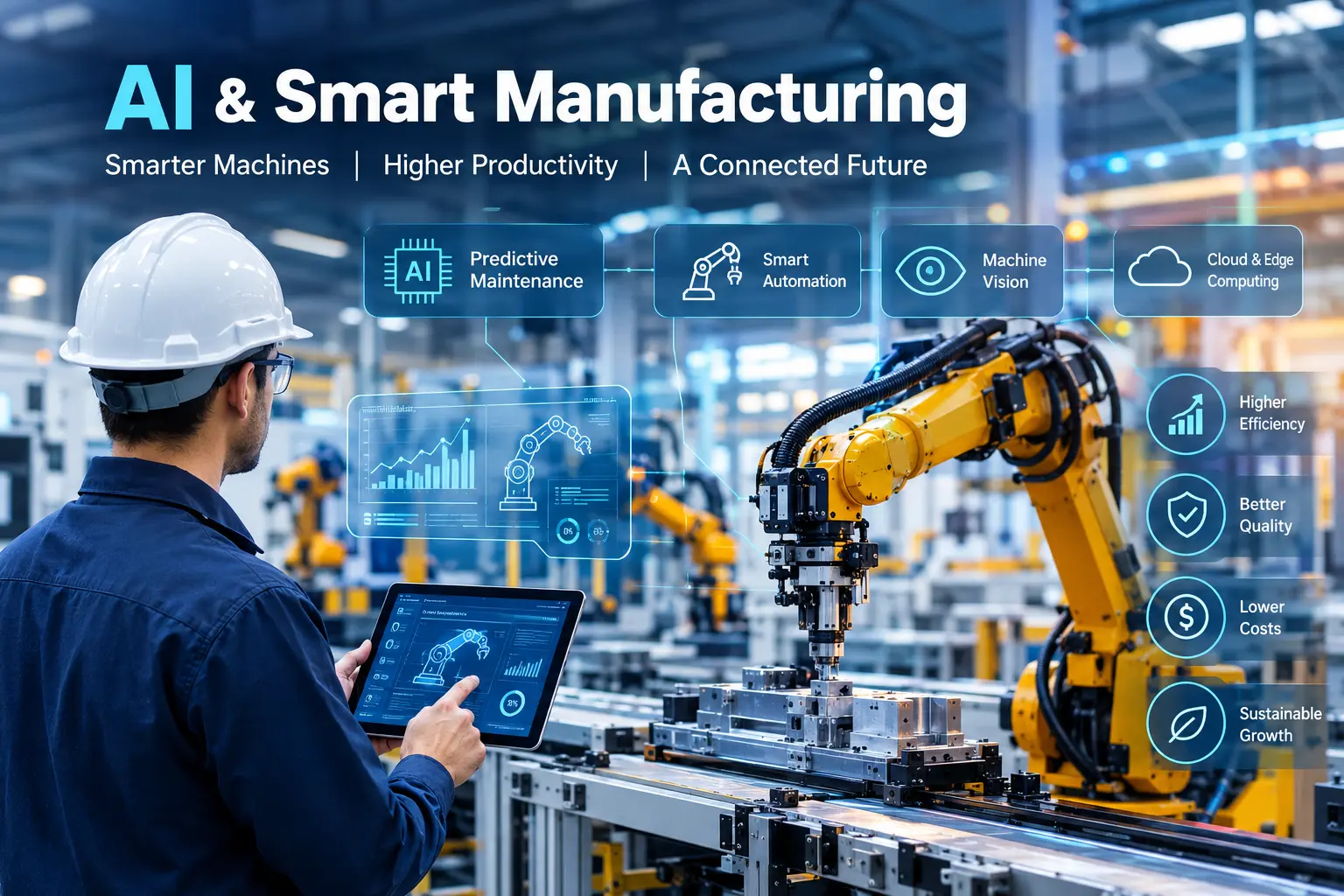
For most of the past decade, the biggest advances in artificial intelligence lived almost entirely inside computers, generating text, analyzing images, and making predictions from data without ever touching the physical world directly. Physical AI represents a genuinely different chapter, referring to AI systems that perceive their surroundings, reason about them, and take physical action in the real world, most visibly through robots that can manipulate objects, navigate spaces, and adapt to situations they were never explicitly programmed to handle. Manufacturing has emerged as one of the most important proving grounds for this technology, precisely because factories offer a controlled, high value environment where the economic case for getting physical AI right is unusually strong.
This shift is distinct from the industrial automation manufacturers have used for decades. A traditional robot executes a fixed, pre programmed sequence of motions with no real understanding of what it is doing, while a physical AI system builds an internal model of its environment and the task at hand, allowing it to generalize to variations it has never explicitly seen before. This guide explains what physical AI actually means in a manufacturing context, the technologies making it possible, where it genuinely differs from the automation and robotics manufacturers already use, and a realistic picture of what to expect by 2027.
What Physical AI Actually Means
Physical AI refers to artificial intelligence systems designed to operate in and act upon the physical world, combining perception, such as computer vision and other sensor input, with reasoning and decision making, and ultimately physical action through motors, grippers, or other actuators. The defining characteristic that separates physical AI from earlier generations of robotics is that these systems learn generalizable skills and internal representations of the physical world, rather than being explicitly programmed with every specific motion and rule needed for a task. A physical AI system trained to pick up objects, for example, ideally learns a general understanding of grasping that transfers to new object shapes and positions it has never specifically encountered, rather than needing to be reprogrammed for every new variation the way a traditional fixed automation system would require.
Why Manufacturing Is the Leading Proving Ground
Manufacturing offers a uniquely favorable environment for developing and deploying physical AI compared to many other real world domains. Factories are relatively structured and controlled compared to open environments such as public roads or private homes, reducing some of the unpredictability that makes physical AI extremely difficult in less constrained settings. At the same time, manufacturing offers a massive economic incentive, since even modest improvements in flexibility, quality, or labor efficiency translate directly into meaningful financial return across the enormous scale of global industrial production. The combination of a relatively controlled environment and an enormous addressable economic opportunity is exactly why so much of the current investment and research attention in physical AI is concentrated specifically on manufacturing and warehouse logistics applications rather than more open ended, unpredictable real world settings.
The Key Technologies Making Physical AI Possible
Foundation Models for Robotics
Just as large language models learned broad, generalizable patterns from massive amounts of text, a new generation of robotics foundation models is being trained on enormous volumes of robot motion, sensor, and outcome data, learning generalizable physical skills that can then be fine tuned for a specific manufacturer's exact task and equipment. This approach dramatically reduces the amount of task specific training data a manufacturer needs to collect compared to training an entirely custom model from scratch for every new application.
Simulation and Sim-to-Real Training
Training a physical AI system entirely on a real factory floor would be prohibitively slow, expensive, and risky, since early stage models inevitably make mistakes that could damage equipment or products. Instead, much of the training happens inside highly realistic physics simulations, where a model can practice a task millions of times at high speed and low cost before being transferred to real physical hardware, a process known as sim-to-real transfer. Advances in simulation fidelity have been a major factor in accelerating physical AI progress, since a simulation that too poorly matches real world physics produces a model that fails to generalize once deployed on actual equipment.
Multimodal Perception
Physical AI systems increasingly combine multiple types of sensor input, including standard cameras, depth sensors, force and torque feedback, and sometimes audio, into a single unified understanding of their environment, allowing them to handle tasks that would be difficult or impossible using vision alone, such as precisely judging how much force to apply when inserting a delicate component or recognizing when a grasped object is at risk of slipping.
World Models
An emerging and particularly important technical direction involves training AI systems to build an internal predictive model of how the physical world behaves, allowing the system to essentially imagine the likely outcome of a potential action before actually performing it. This capability is what allows a genuinely capable physical AI system to plan several steps ahead and recover gracefully from unexpected situations, rather than simply reacting moment to moment the way earlier generations of robotic control systems typically did.
How Physical AI Differs From Traditional Industrial Automation
| Characteristic | Traditional Industrial Automation | Physical AI Systems |
|---|---|---|
| How Tasks Are Defined | Explicitly programmed, fixed sequence of motions | Learned from data, generalizes to new variations |
| Handling Unexpected Situations | Requires a human to intervene or reprogram | Can adapt or attempt recovery autonomously |
| Setup for a New Task | Manual reprogramming or reconfiguration | Fine tuning an existing general purpose model |
| Reliance on Structured Environment | High, expects precise, consistent conditions | Lower, designed to tolerate more variation |
| Maturity in 2026 | Extremely mature, decades of proven deployment | Early stage, rapidly improving but limited in scope |
Emerging Applications Already Moving Into Real Production
While fully general purpose physical AI remains an ambitious long term goal, several narrower applications are already moving from research demonstrations into limited real production use. Adaptive bin picking, where a robot identifies and grasps parts that are randomly oriented and jumbled together in a container, has become one of the more mature physical AI applications, since it directly addresses a task that traditional fixed automation has always struggled with due to the inherent unpredictability of part position and orientation. Flexible assembly tasks involving parts with natural variation, such as inserting cables or fasteners into openings with slightly inconsistent tolerances, are also seeing early physical AI deployment, since these tasks benefit enormously from a system that can adjust its exact motion based on real time force feedback rather than following a rigid, pre programmed path. General purpose humanoid and mobile manipulation robots, designed to operate in spaces built for human workers without extensive facility redesign, remain earlier stage but are moving into pilot trials at a growing number of manufacturers, particularly for material handling and simple kitting tasks in facilities not easily retrofitted with fixed automation.
A Realistic Timeline: What to Expect by 2027
Manufacturers should approach physical AI with a healthy dose of realism about how quickly it will actually transform the factory floor. By 2027, expect continued rapid improvement in narrow, well defined physical AI applications such as adaptive bin picking and flexible assembly, with a growing number of manufacturers deploying these capabilities in limited, well scoped production roles. General purpose humanoid robots and fully autonomous, broadly capable manufacturing robots are likely to remain in earlier stage pilot deployment during this period rather than achieving widespread commercial adoption, constrained by cost, reliability, and the practical challenge of safely certifying highly adaptive systems for widespread industrial use. Manufacturers should expect physical AI to arrive gradually, application by application, rather than as a single sweeping transformation, much the way earlier automation technologies took years to move from early adopter deployment to broad industry standard practice.
The Economics of Physical AI Compared to Traditional Automation
The financial case for physical AI differs meaningfully from the case for traditional fixed automation, and manufacturers evaluating early adoption should understand this difference clearly. Traditional automation typically delivers its strongest return through high volume repetition of a single, well defined task, spreading the upfront engineering and integration cost across an enormous number of production cycles. Physical AI systems, particularly those built on general purpose foundation models, are designed to justify their cost differently, by amortizing the underlying model development across many different tasks and even many different customers, then relying on a much smaller amount of task specific fine tuning to adapt that general capability to a specific manufacturer's needs. This means the economics of physical AI are likely to improve fastest for manufacturers with a wide variety of smaller, varied tasks that would each individually be too small to justify a dedicated traditional automation project, but which collectively become attractive once a single flexible physical AI platform can be fine tuned to handle many of them.
The Role of Data Ownership and Competitive Advantage
As physical AI systems increasingly depend on large volumes of task specific data to fine tune their general capabilities for a particular application, the data a manufacturer generates through its own production operations is likely to become an increasingly important competitive asset. Manufacturers that begin systematically capturing high quality data about their specific tasks, including sensor readings, outcomes, and any human corrections made during current semi automated processes, are building a valuable resource that will make future physical AI fine tuning faster and more effective compared to competitors starting from a much smaller or lower quality data foundation. This dynamic mirrors a pattern already familiar from software based AI, where the organizations with the richest, most relevant proprietary data often gain a durable advantage in how effectively they can apply increasingly capable general purpose AI models to their specific needs.
Challenges and Risks That Will Shape Adoption Speed
Several genuine challenges will determine how quickly physical AI actually moves from promising demonstration to widespread manufacturing deployment. Safety certification remains a significant hurdle, since traditional industrial safety standards were largely designed around predictable, fixed automation behavior, and regulators and standards bodies are still working through how to properly evaluate and certify systems whose behavior is learned and adaptive rather than fully deterministic. Reliability at scale is another open question, since a physical AI system that performs impressively in a controlled demonstration or limited pilot does not automatically translate to the same reliability across thousands of repetitions in a real, messy production environment over months or years of continuous operation. Cost also remains a meaningful barrier for the most advanced physical AI hardware and software, particularly for general purpose humanoid platforms, meaning near term adoption is likely to remain concentrated among larger manufacturers and specific high value applications where the economic case is strongest, rather than becoming immediately accessible to smaller operations.
How Manufacturers Should Prepare Now
Even though widespread physical AI adoption remains a multi year journey, manufacturers can take practical steps today to position themselves well for this transition. Building strong foundational data infrastructure, including reliable sensors and a unified data architecture, matters just as much for future physical AI applications as it does for the predictive maintenance and quality inspection applications already common today, since physical AI systems ultimately depend on rich, well structured data about the tasks and environments they operate in. Identifying specific, well scoped tasks within the operation that are currently difficult or impractical to automate with traditional fixed automation, such as tasks involving significant part variation or requiring adaptive force control, gives manufacturers a natural starting point for evaluating early physical AI pilots as the technology matures. Building internal familiarity with the technology through smaller, lower risk pilot projects, rather than waiting for fully mature, broadly proven solutions, also helps manufacturing organizations develop the internal expertise and organizational comfort needed to scale physical AI deployment more quickly once the technology reaches the reliability and cost thresholds needed for broader adoption.
How Physical AI Connects to the Broader Smart Factory Data Ecosystem
Physical AI systems do not operate in isolation from the rest of a manufacturer's technology infrastructure, and their long term value depends heavily on how well they connect into the broader connected factory data ecosystem discussed throughout this guide. A physical AI system performing adaptive assembly, for example, generates a continuous stream of data about grasp attempts, force readings, and task outcomes that becomes considerably more valuable when it flows into the same unified data infrastructure feeding a manufacturer's predictive maintenance and quality inspection systems, rather than remaining isolated within the robot's own control system. This connectivity allows physical AI performance data to inform broader process improvement decisions, and conversely allows physical AI systems to benefit from context generated elsewhere in the operation, such as quality inspection results that reveal specific failure patterns the physical AI system's own task execution should be adjusted to avoid. Manufacturers already investing in strong data infrastructure for their current smart factory initiatives are effectively building the foundation that will make future physical AI adoption considerably smoother than it would be for an organization still relying on disconnected, siloed systems.
Frequently Asked Questions
Is physical AI the same thing as a humanoid robot?
No, physical AI is a broader category referring to any AI system that perceives and acts in the physical world, which includes humanoid robots but also covers robotic arms, autonomous mobile robots, and other physical systems that do not resemble a human form at all.
Will physical AI replace traditional industrial robots by 2027?
Unlikely in most applications, since traditional fixed automation remains more cost effective and reliable for high volume, well defined tasks, with physical AI expected to complement rather than replace traditional robotics, particularly for tasks involving variability and adaptability that fixed automation has always struggled to handle well.
How is a physical AI system trained differently from a traditional robot programmed?
A traditional robot is explicitly programmed with a fixed sequence of motions for a specific task, while a physical AI system is typically trained on large volumes of data, often generated through simulation, to learn generalizable skills that can then be fine tuned for a manufacturer's specific application without needing to be reprogrammed from scratch.
What manufacturing tasks are most likely to see physical AI adoption first?
Tasks involving significant part variation or unpredictability, such as bin picking randomly oriented parts or handling flexible materials, are likely to see the earliest and most successful physical AI adoption, since these tasks have always been genuinely difficult for traditional fixed automation to handle reliably.
Should smaller manufacturers start planning for physical AI now?
Smaller manufacturers should focus primarily on building strong foundational data and connectivity infrastructure now, since this groundwork benefits current automation investments as well as future physical AI adoption, while likely waiting for costs to decrease and reliability to improve further before committing to the most advanced physical AI hardware currently available.
What role does simulation play in reducing the risk of physical AI adoption?
Simulation allows a physical AI system to be trained and extensively tested on millions of virtual attempts at a task before ever touching real production equipment, significantly reducing the risk of damage to products or machinery during the early, error prone stages of training that would otherwise be unacceptably costly and disruptive if performed directly on a live production line.
How can a manufacturer tell whether a vendor's physical AI claims are realistic?
Manufacturers should ask for evidence of performance on tasks and conditions genuinely similar to their own specific application, ideally through a reference deployment or a structured pilot using their own real parts and production conditions, rather than relying solely on an impressive but narrowly scoped demonstration that may not reflect how the system performs under the variability of actual, sustained production use.
Final Thoughts
Physical AI represents a genuinely different paradigm from the fixed, explicitly programmed automation that has defined manufacturing for decades, promising systems that can generalize, adapt, and recover from unexpected situations rather than simply executing a rigid predetermined sequence. Manufacturing's structured environment and enormous economic scale make it one of the most important proving grounds for this technology, and narrow, well scoped applications such as adaptive bin picking and flexible assembly are already moving into real production use. However, manufacturers should expect this transformation to unfold gradually through 2027 and beyond, application by application, rather than as a sudden, sweeping replacement of existing automation, and the organizations that begin building strong data foundations and identifying well suited pilot applications today will be best positioned to adopt this technology quickly as it continues to mature.