If you are looking for a simple, safe and completely free way to enjoy movies and series on your cell phone, tablet or TV, Tubi – Free Movies and Series stands out as one of the best options available in 2026. With an impressive collection, a clean interface, and support for Portuguese subtitles, the app offers access to thousands of titles free of charge. And best of all, it's available for direct download from the official stores:

Tubi: Free Movies & Live TV
How AI Is Turning Traditional Machines Into Autonomous Industrial Systems
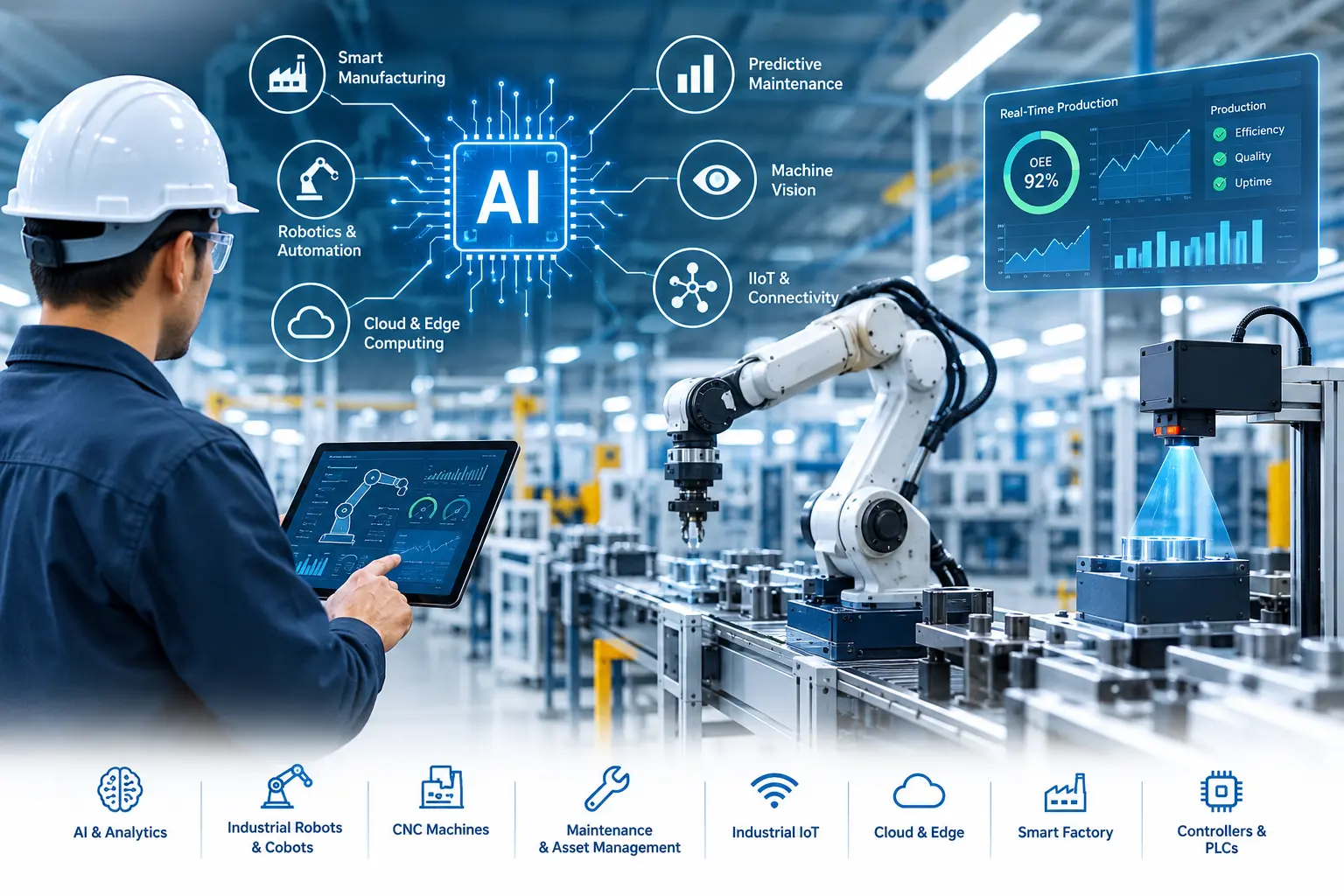
Most of the machinery running on factory floors today was never designed to think for itself. A conventional CNC lathe, a fixed speed conveyor motor, or a decades old hydraulic press was built to execute a fixed set of instructions reliably, with a human operator responsible for watching gauges, adjusting settings, and deciding when something needed attention. That model worked for a long time, but it is rapidly being replaced by a very different one, where the same physical machines, often without any major mechanical changes, are being layered with sensors, edge computing, and artificial intelligence until they behave less like passive tools and more like autonomous systems capable of monitoring, adjusting, and even correcting themselves.
This shift does not usually happen by ripping out old equipment and replacing it with something entirely new. In most factories, it happens through retrofitting, adding a layer of intelligence on top of machinery that may already be ten, twenty, or even thirty years old. Understanding how this transformation actually works, what level of autonomy is realistic for a given piece of equipment, and how to approach a retrofit project without disrupting production is quickly becoming one of the most important strategic questions facing manufacturing leadership in 2026.
What Does Autonomous Actually Mean for Industrial Machinery?
The word autonomous gets used loosely in manufacturing conversations, so it helps to define it precisely. An autonomous industrial system is one that can sense its own operating condition and the state of its environment, make a decision based on that information without waiting for a human instruction, and act on that decision, whether that means adjusting a process parameter, triggering a maintenance alert, or physically repositioning itself. This is a spectrum rather than a single destination. A machine with a basic vibration sensor that simply logs data for a human to review later sits at one end of that spectrum, while a fully self optimizing production cell that adjusts its own speed, catches its own defects, and schedules its own maintenance without any human involvement sits much closer to the other end.
The Five Layers That Turn a Traditional Machine Into an Autonomous One
Layer One: Sensing
Autonomy starts with the ability to perceive. Retrofitting a traditional machine with vibration sensors, temperature probes, current transducers, pressure gauges, or cameras gives it, for the first time, a continuous stream of data about its own condition and output. Without this layer, none of the more advanced capabilities described below are possible, since a machine cannot make an intelligent decision about a state it cannot measure.
Layer Two: Connectivity
Sensor data is only useful if it can travel somewhere it can be processed. This layer includes the industrial networking, whether wired or wireless, that carries data from the machine to an edge computing device on the factory floor or to a cloud based platform. For older equipment, this often means adding a gateway device that translates legacy communication protocols into a format modern software can actually work with.
Layer Three: Intelligence
This is where artificial intelligence enters the picture directly. Machine learning models process the incoming sensor data to detect patterns, predict outcomes such as an impending failure, and recommend or determine the appropriate response. This layer is what separates simple condition monitoring, which only reports what is happening, from genuine intelligence, which interprets what it means and what should be done about it.
Layer Four: Actuation
Sensing and deciding are not enough on their own. An autonomous system needs the ability to act, whether that means automatically adjusting a machine's speed or temperature setpoint, triggering a robotic arm to reposition a part, or shutting down a process before a developing fault causes damage. Retrofitting actuation capability onto older equipment often requires adding programmable controllers or actuator modules that can receive commands from the intelligence layer and translate them into physical adjustments.
Layer Five: Coordination
The most advanced autonomous systems do not operate in isolation. This final layer allows individual autonomous machines to communicate and coordinate with each other, such as an autonomous mobile robot adjusting its delivery schedule based on a machine reporting it will finish its current job early, or an entire production cell rebalancing workload automatically when one station reports reduced capacity due to a developing mechanical issue. Coordination is also where the value of autonomy tends to compound, since a single intelligent machine can only optimize its own performance, while a coordinated group of intelligent machines can optimize the performance of an entire production line or cell as a whole, catching inefficiencies that would be invisible when looking at any one machine in isolation.
Levels of Industrial Autonomy: A Practical Scale
| Level | Description | Typical Capability |
|---|---|---|
| Level 0 | Manual operation | No sensors beyond basic gauges, fully human operated and monitored |
| Level 1 | Connected monitoring | Sensors installed and data logged, but decisions remain entirely human made |
| Level 2 | Assisted decision making | System generates alerts and recommendations, human confirms and executes action |
| Level 3 | Conditional autonomy | System automatically adjusts within defined limits, escalates to a human outside those limits |
| Level 4 | High autonomy | System handles most routine decisions independently, human oversight remains for exceptions |
| Level 5 | Full autonomy | System operates, adapts, and self corrects with minimal to no ongoing human intervention |
Most factories today have a mix of machines sitting at different points on this scale, and that is entirely normal. Pursuing level five autonomy across every piece of equipment is rarely the right goal, since many stable, low risk processes deliver plenty of value from level two or three capability without the added cost and complexity of pushing further.
Retrofitting Legacy Equipment: What Is Actually Possible
One of the most common misconceptions about industrial autonomy is that it requires buying entirely new machinery. In practice, a large share of the autonomy improvements happening on factory floors in 2026 involve retrofitting existing, sometimes decades old equipment. Wireless vibration and temperature sensors can be magnetically mounted to almost any rotating equipment without modifying the machine itself. Retrofit current sensors can be clamped onto existing electrical panels to monitor motor load without any rewiring. Vision systems can be mounted above or beside an existing production line to add automated inspection capability without touching the underlying process equipment at all. Even actuation, the ability for a system to act on what it senses, can often be added through retrofit programmable logic controllers or variable frequency drives that interface with a machine's existing control inputs rather than replacing the machine's core mechanical systems.
The main constraint on retrofitting is usually not whether it is technically possible, but whether the economics make sense compared to eventual full replacement. Equipment with a long remaining useful life and a stable core mechanical design is generally an excellent retrofit candidate, while equipment already nearing the end of its service life or facing an imminent redesign may be better served by waiting for full replacement rather than investing in a retrofit that will only be in service a short time.
Real World Examples Across Common Machine Types
CNC Machines
Older CNC machines are being retrofitted with vibration and current sensors that feed into adaptive control software, allowing the machine to adjust cutting speed and feed rate in real time based on actual tool wear and material conditions, rather than running the fixed, conservative parameters originally programmed decades earlier.
Pumps and Motors
Rotating equipment such as pumps, fans, and motors is one of the easiest and most common retrofit targets, since wireless vibration sensors can be added in minutes and immediately begin feeding a predictive maintenance model, turning equipment that previously had no condition awareness into a system that can flag developing bearing or alignment issues weeks in advance.
Conveyor and Material Handling Systems
Fixed speed conveyors are increasingly being paired with variable frequency drives and simple AI based load sensing, allowing the conveyor to automatically adjust its speed based on downstream buffer levels rather than running at a single constant speed regardless of actual production conditions.
Older Industrial Robots
Robotic arms originally programmed for a single fixed task can gain a meaningful capability upgrade by adding a vision system to their existing controller, allowing them to adapt their grip position for parts that are not perfectly aligned, without needing to replace the robot itself.
The Business Case for Autonomy Retrofits
The financial case for turning traditional machinery into autonomous or semi autonomous systems rests on a few consistent pillars. Reduced unplanned downtime is usually the largest and most immediate benefit, since even basic sensing and alerting capability added to previously unmonitored equipment can catch developing failures early enough to schedule a planned repair instead of absorbing an unplanned stoppage. Extended equipment lifespan is a second major benefit, since machines that are monitored and adjusted based on actual operating condition tend to experience less accumulated stress than equipment run at fixed, conservative settings originally chosen without the benefit of real time data. Labor efficiency also improves, since autonomous or semi autonomous machines require less constant manual monitoring, freeing operators to oversee a larger number of machines or focus on higher value tasks. Finally, retrofitting existing equipment is almost always dramatically cheaper than full replacement, meaning manufacturers can capture a meaningful share of the benefits associated with brand new autonomous machinery at a fraction of the capital cost.
Challenges to Address Before Starting a Retrofit Program
Turning traditional machines into autonomous systems is not without real challenges that manufacturers need to plan for in advance. Legacy control systems sometimes use older communication protocols that are not natively compatible with modern software platforms, requiring protocol translation gateways that add both cost and a potential point of failure to the overall system. Data quality can also be an issue on older equipment where sensor placement is constrained by the machine's original mechanical design, sometimes requiring compromises in sensor positioning that reduce the accuracy of the resulting data compared to a purpose built new machine. Workforce readiness is another common obstacle, since operators and maintenance technicians accustomed to a fully manual machine need training and, just as importantly, a level of trust in the new system before they will actually act on its recommendations rather than falling back on old habits. Finally, cybersecurity needs serious attention any time a previously isolated piece of equipment is connected to a broader network, since older machines were never designed with modern security threats in mind and can become a vulnerable entry point if not properly segmented and protected.
A Practical Roadmap for Retrofitting Toward Autonomy
Manufacturers approaching this transformation get the best results by moving through a deliberate sequence rather than attempting to add every layer of autonomy to every machine at once. The process typically begins by selecting a small number of critical or high value machines as a pilot group, chosen based on how much downtime or quality risk they currently represent. Sensors and connectivity are then added first, since even basic condition monitoring alone often delivers immediate value and helps build organizational confidence in the broader initiative. Once a reliable data stream is established, an intelligence layer, whether a predictive maintenance model, an adaptive control algorithm, or a vision based inspection system, can be layered on top and validated against real operating history before being trusted to influence live decisions. Actuation capability is added only after the intelligence layer has proven reliable, since allowing a system to automatically act on its own recommendations carries more risk than simply alerting a human, and this step should be approached incrementally, starting with narrow, well bounded adjustments before expanding scope. Finally, coordination between multiple autonomous machines is typically the last capability added, once individual machines are already operating reliably at a higher level of autonomy on their own.
Cybersecurity Considerations for Newly Connected Legacy Equipment
Every sensor, gateway, or network connection added during a retrofit expands the potential attack surface of equipment that may never have been connected to any network before. Manufacturers should treat network segmentation as a non negotiable requirement, keeping newly connected operational technology on a separate network segment from general business systems so that a breach in one area cannot easily spread to the other. Retrofit devices and gateways should also be kept on a regular firmware update schedule, since older industrial equipment vendors sometimes lag behind in patching known vulnerabilities compared to modern information technology hardware. Continuous network monitoring, ideally using tools specifically designed for operational technology environments rather than standard information technology security software, helps catch unusual communication patterns that could indicate a compromised device before it causes operational disruption.
Measuring Whether an Autonomy Retrofit Is Actually Working
Manufacturers need clear metrics to confirm that an autonomy retrofit is delivering real value rather than just adding complexity to a previously simple machine. Tracking the frequency and duration of unplanned stoppages before and after the retrofit is the most direct measure, since a genuine improvement in machine intelligence should show up as fewer and shorter unexpected interruptions over time. The ratio of automated decisions to escalated human decisions is another useful indicator, particularly for machines operating at conditional autonomy levels, since a healthy system should show this ratio shifting steadily toward more automated handling as the model gains confidence and the team builds trust in its recommendations. Energy consumption per unit produced is worth monitoring as well, since many autonomy upgrades include adaptive control capability that optimizes operating parameters in ways that reduce waste without any explicit energy focused initiative. Finally, tracking how operators and maintenance staff actually respond to system recommendations, whether they routinely follow them, frequently override them, or ignore them entirely, reveals whether the human side of the autonomy equation is functioning as intended, since even a technically excellent system delivers little value if the people working alongside it do not trust or act on its output.
How Autonomy Retrofits Fit Into a Broader Digital Transformation Strategy
Individual machine level autonomy retrofits deliver value on their own, but the biggest returns tend to appear once several autonomous or semi autonomous machines are connected into a broader digital ecosystem. A predictive maintenance model running on a single retrofitted pump delivers real value in isolation, but that same data becomes far more powerful when it feeds into a plant wide maintenance scheduling system that can coordinate technician time and spare parts inventory across dozens of similarly retrofitted assets. Similarly, an adaptive CNC machine that optimizes its own cutting parameters becomes even more valuable when its performance data feeds into a production scheduling system that can route future orders toward whichever machine is currently running most efficiently. Manufacturers planning a retrofit program should therefore think beyond the immediate machine level benefit and consider from the outset how the data being generated could eventually connect into manufacturing execution systems, enterprise resource planning platforms, and plant wide analytics dashboards, since designing for that connectivity early avoids costly rework later when the organization decides to scale the initiative beyond its initial pilot machines.
Frequently Asked Questions
Can any traditional machine be turned into an autonomous system?
Most mechanically sound equipment can gain at least some level of autonomy through sensor and software retrofits, though the achievable level depends on the machine's existing control architecture, with older equipment lacking any programmable control interface generally limited to lower autonomy levels focused on monitoring and alerting rather than automated action.
How much does it typically cost to retrofit a machine for autonomy?
Costs vary significantly based on the target autonomy level, ranging from a relatively modest investment for basic sensing and monitoring capability to a much larger project for machines being upgraded with full adaptive control and actuation, though retrofitting is almost always considerably less expensive than replacing the equipment entirely.
Is it safer to retrofit old equipment or replace it with new autonomous machinery?
Both approaches can be done safely with proper engineering, but retrofits require careful attention to the condition of the underlying mechanical system, since adding intelligence to a machine with existing mechanical wear or fatigue issues does not fix those underlying problems and may simply automate a process that still has a latent mechanical risk.
How long does a typical autonomy retrofit project take?
Simple sensing and monitoring retrofits can often be completed within days to a few weeks per machine, while more advanced projects involving adaptive control and actuation typically take several months to properly validate before the system can be trusted to operate with reduced human oversight.
Do operators need retraining after a machine becomes more autonomous?
Yes, operators typically need training not just on how to use any new interface, but on how to interpret the system's recommendations and understand when and why it might take automated action, since a lack of trust or understanding is one of the most common reasons autonomy retrofits underperform their technical potential.
Final Thoughts
The transformation of traditional industrial machinery into autonomous systems is happening gradually, one sensor, one model, and one control loop at a time, rather than through a single dramatic overhaul. Manufacturers do not need to replace their entire equipment fleet to participate in this shift, and in most cases they should not, since retrofitting existing, mechanically sound machinery with sensing, intelligence, and carefully scoped actuation delivers a strong return without the capital expense of full replacement. The factories that succeed with this transition in 2026 and beyond will be the ones that approach autonomy as a deliberate, staged journey matched to each machine's actual condition and role, rather than treating it as a single technology purchase to be applied uniformly across the entire plant.